Nixon, Volume II by Stephen E. Ambrose
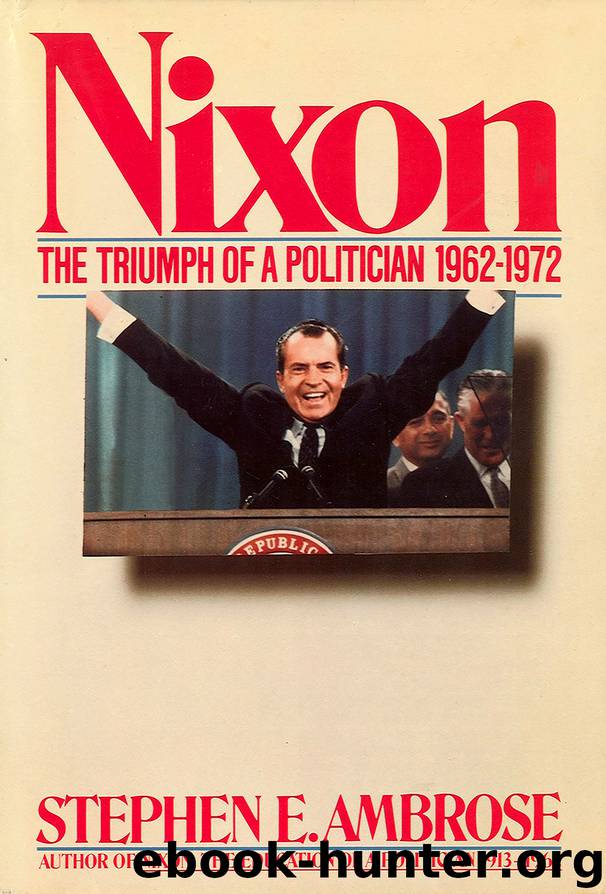
Author:Stephen E. Ambrose
Language: eng
Format: epub
Publisher: Simon & Schuster
CHAPTER SEVENTEEN
THE TENTH CAMPAIGN
September–December 1970
AT THE BEGINNING of the campaign season in 1970, James Reston wrote a piece on the mood of the electorate. He said that despite the passionate political minorities, a majority of the people believed that although the Vietnam War was a mess and a mistake, “after all, it is coming to an end.” The majority further believed that the rebellious kids were both wrong and a menace; that more cops and tougher judges and additional laws were needed to stop crime, rather than more antipoverty programs; that “taxes are too damn high”; that the Supreme Court had assumed too much “legislative power”; that the poor were poor because they would not work and had too many kids; that education was in trouble because “they” were teaching everything but what counted, reading and writing; that blacks had rights but forced integration would leave everybody worse off; that a major national problem was “permissive parents”; that private enterprise could do anything better than government; that growth was not only inevitable but good, and that thus big business was good and bigger business was better; that big government was terrible and bigger government was dangerous.1
Nixon seldom agreed with Reston, but this time he was in complete accord. “H & E,” he scribbled on his News Summary, “Note—even from this quarter!”
And he continued: “We’d better shape up and quit trimming the wrong way. It is very late—but we still have time to move away from the line of our well intentioned liberals on our staff. . . . I can’t emphasize too strongly my concern that our team has been affected too much by the unreal atmosphere of the D.C. press, social, and intellectual set.”
Nixon offered an explanation of how such attitudes had developed: “Cambodia and Kent State led to an overreaction by our own people to prove that we were pro student, blacks, left.”
Then he gave his orders: “H—E—Finch. We must get turned around on this before it is too late—Emphasize—anti-Crime—anti-Demonstrations—anti-Drug—anti-Obscenity—Get in touch with the mood of the country which is fed up with the Liberals. This stuff is dynamite politically.”2
A week later, the News Summary reported plans for massive peace demonstrations on October 31 in twenty cities, to be organized by a coalition of student groups and the National Alliance of Postal and Federal Employees. Nixon wrote in the margin, “H—Priority! Encourage them.”3
Informed that the Democrats were planning to make a campaign issue of Agnew’s “words and views,” Nixon commented, “Great! For us.”4
When Scanlan’s Monthly published a memorandum linking Agnew to a purported plan to cancel the 1972 election and repeal the Bill of Rights, Nixon furiously demanded a lawsuit, an FBI investigation, an apology, and so forth. John Dean, a thirty-one-year-old lawyer who had left the Justice Department in July of 1970 to join the White House staff as Counsel to the President, informed Nixon that there was no basis for a lawsuit, and advised the President to ignore the bogus memo.
Instead, Nixon wrote at the bottom of Dean’s recommendation, “H—Have I.
Download
This site does not store any files on its server. We only index and link to content provided by other sites. Please contact the content providers to delete copyright contents if any and email us, we'll remove relevant links or contents immediately.
Fanny Burney by Claire Harman(26660)
Empire of the Sikhs by Patwant Singh(23135)
Out of India by Michael Foss(16986)
Leonardo da Vinci by Walter Isaacson(13411)
Small Great Things by Jodi Picoult(7226)
The Six Wives Of Henry VIII (WOMEN IN HISTORY) by Fraser Antonia(5558)
The Wind in My Hair by Masih Alinejad(5139)
A Higher Loyalty: Truth, Lies, and Leadership by James Comey(5017)
The Crown by Robert Lacey(4862)
The Lonely City by Olivia Laing(4841)
Millionaire: The Philanderer, Gambler, and Duelist Who Invented Modern Finance by Janet Gleeson(4538)
The Iron Duke by The Iron Duke(4405)
Papillon (English) by Henri Charrière(4322)
Sticky Fingers by Joe Hagan(4255)
Joan of Arc by Mary Gordon(4156)
Alive: The Story of the Andes Survivors by Piers Paul Read(4077)
Stalin by Stephen Kotkin(4006)
Aleister Crowley: The Biography by Tobias Churton(3671)
Ants Among Elephants by Sujatha Gidla(3494)
